AI adoption usually starts with tools.
A chatbot here. An assistant there. Something that promises quick wins without disrupting the business.
We see this approach everywhere.
The problem is not that AI tools are bad.
It is that tools are mistaken for systems.
That confusion explains why many AI initiatives stall or quietly fade away.
Tools solve moments. Systems support operations.
AI tools are designed to solve specific tasks.
Writing assistance. Data summarization. Pattern recognition. Content generation.
Used in isolation, they can be helpful.
What they do not do is change how the business operates.
AI systems are different.
They are designed around workflows, data flow, ownership, and outcomes. They integrate into how work moves instead of sitting alongside it.
We see businesses adopt AI tools quickly, then wonder why nothing really changed.
Why AI tools feel productive but don’t scale
AI tools often create the feeling of productivity.
Someone completes a task faster. Another saves time drafting something. The improvement is visible.
What does not change is the overall flow of work.
Decisions still move slowly. Handovers still rely on people. Data still needs reconciliation.
We see AI tools reduce effort locally while leaving systemic friction untouched.
This is why early enthusiasm often fades.
AI systems require design, not experimentation
Building AI systems requires intention.
Clear inputs. Defined outputs. Ownership. Rules for exceptions.
This is uncomfortable work, especially when teams want fast results.
We see businesses experiment endlessly with tools instead of designing systems once.
The result is scattered usage, inconsistent outcomes, and low trust.
AI systems succeed when they are treated as part of the operating model, not as add-ons.
A situation we see often
We recently spoke with a company that had adopted multiple AI tools across teams.
Marketing used one. Operations tried another. Leadership experimented separately.
Each tool delivered some value.
Collectively, nothing improved.
Data was still fragmented. Decisions still relied on manual review. No shared system existed.
Once the business aligned on a few core workflows and built AI support into them, usage stabilized and outcomes improved.
The tools did not change.
The system did.
Why integration matters more than capability
One misconception we see is focusing on how powerful an AI tool is.
Capability matters less than integration.
An average AI model embedded in a clear system often outperforms an advanced model used ad hoc.
We see businesses chase features while ignoring fit.
AI systems succeed when they support how the business actually works.
AI systems create accountability
One benefit of AI systems is clarity around ownership.
When AI outputs feed into workflows, responsibility becomes explicit. Someone reviews. Someone decides. Someone handles exceptions.
This prevents the common problem of “the AI said so.”
We see trust increase when accountability is clear.
Why most businesses stop at tools
The reason many businesses stop at AI tools is simple.
Tools are easy. Systems are hard.
Tools require little alignment. Systems require decisions.
AI systems force businesses to clarify workflows, data sources, and decision rules.
That clarity is uncomfortable but necessary.
When AI systems actually work
We see AI systems work when:
They are built around stable workflows.
They support specific decisions.
They have clear ownership.
They integrate into existing systems.
In these cases, AI becomes invisible. It just works.
That invisibility is a sign of success.
Final thought
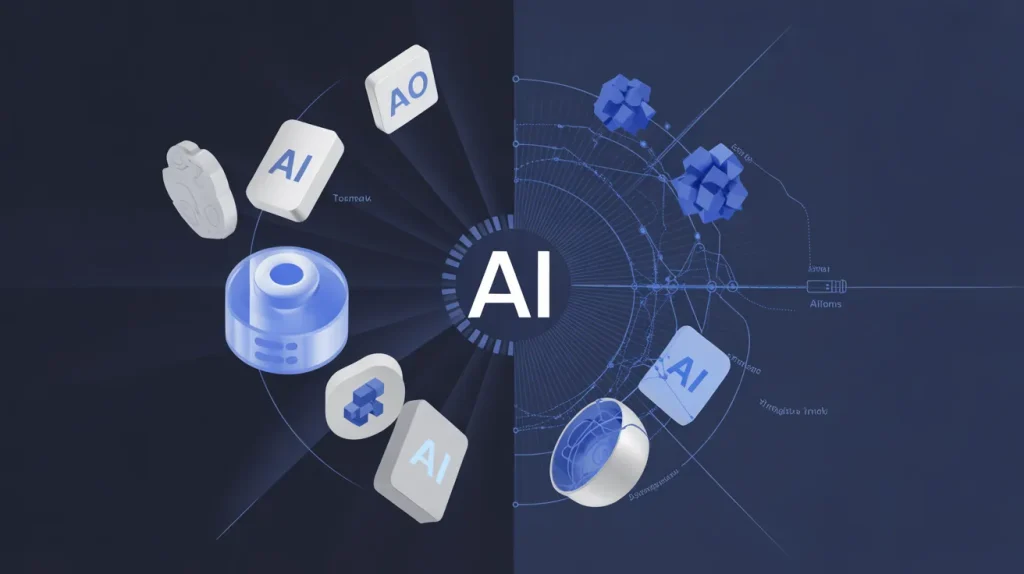
AI tools can improve moments.
AI systems improve operations.
When businesses understand the difference, AI stops being an experiment and starts becoming infrastructure.
The shift from tools to systems is where real value appears.